
PUBLISHED: December 27, 2023 | By Steve Horvath
- State legislative reform is the most reasonable means to positively impact a majority of the over 70,000,000 estimated homeowners and residents living in 350,000+ community associations across the United States, but regulatory reform is most often a years-long process and intended to create progress, not perfection. Individual communities must take action – including electing leaders who are willing to sacrifice some of their own interests for the benefit of the community – to make a lasting difference.
- Homeowners must establish common ground as a foundation to propel meaningful, timely reforms in every state. Adopting model concepts and language saves time and money otherwise required to create novel approaches while simultaneously reinforcing best practices, leveraging material that’s already law in some states and presenting a unified front that can convincingly tackle CAI’s unrelenting community association business industry bandwagon. Here are three examples:
Full blog document
CURRENT STATE
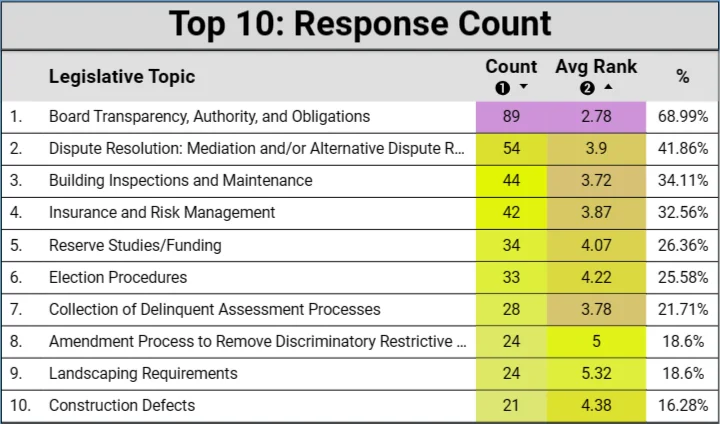
The 2023 Legislative Priorities Survey overwhelmingly confirmed multiple opportunities for community association legislative reform.
ADVOCACY
A relatively small number of dedicated homeowner advocates have attempted to create change by organizing various groups and messaging over the last few decades. Each one of these efforts has its own unique look and feel: some are little more than an individual sending emails, while others recruit volunteers and build websites. Some are focused on a single association while others are state-wide. Only one such organization strives to serve a nation-wide audience and none have established sustainable operations and growth via membership fees. The HOA United resources page features nearly dozen examples of unique organizations.
WHAT’S MISSING?
Homeowners lack a sustainably funded national advocacy organization while businesses (management companies, law firms, reserve consultants, insurance brokers and others) have had a national trade and advocacy organization for decades: the Community Associations Institute (CAI). Doing a double-take? Look no further than the CAI Report Card.
THE DIVIDE
WHY isn’t there a sustainably funded nation-wide organization that represents the best interests of homeowners?
- Approach and Priorities
- Misunderstandings
- Time and Money
WHY isn’t there more meaningful reform happening every year?
- Industry Lobbying
APPROACH and PRIORITIES: By far the #1 one divide. Experts consistently urge balance from the macro such as the environment, to the micro: being active, eating, sleeping, etc. Despite being uniquely situated as hyper-local quasi-governmental entities, community associations require a reasonable balance between the needs and expectations of individual owners and the needs of the association to achieve success.
A number of “pro-homeowner” advocates have directed their energy to suggestions ranging from punitive remedies and neutering rule-making authority to banning foreclosures and eliminating the community association model altogether. Wayward volunteer governance and professional malfeasance that continue to shake the foundations of community association living should not be dismissed or minimized, but punishment and abolishment fail as reasonable remedies in most areas of legislation and regulation. As a prime example, application of the Consumer Protection Act and third-party beneficiary language doomed Washington State’s HB1569 and SB5727 before they were ever written, just as North Carolina’s HB542 has so many prongs that its impressive bi-partisan support isn’t enough to survive the gauntlet of committee and floor votes in both chambers to become law.
MISUNDERSTANDINGS: There’s a lot to know (The Ultimate CIC Challenge: Too Long, Didn't Read. TLDR (TL;DR) The end). Failing to comprehend the requisite breadth and depth of operations and regulations leads to a patchwork of proposals. Community association misunderstandings plague homeowners, professionals and legislators alike. Common sense, while useful in many situations, cannot be applied in broad strokes to a regulatory environment that changes from state-to-state. The federal government will generally not interfere with state sovereign authority to enact laws that regulate community associations.
Understanding all the moving pieces is critical to drafting reasonable legislation that creates the necessary balance between homeowners and community associations. Deeply networked dependencies and detailed processes often defy simplification and can easily occupy multiple paragraphs and pages. The precision of RCW 64.90 already comprises over 16,000 more words than RCW 64.34.
Comprehending at least some of the overall legislative landscape, discussion and progress – or lack thereof – in each state helps assemble a compelling narrative about not only what needs to change, but how best to deliver results.
TIME and MONEY: Operating any business – for profit or not – requires time and money for administration due diligence / research, fundraising, messaging, recruitment and everything in between. There are few volunteers that have the time and/or the money to handle all of the elements required to make these organizations successful.
Most reformers have their hands full grappling with advocacy in their own state and/or community association. Advocacy becomes exponentially more challenging as one crosses borders and juggles a mix of not only more varied concerns, but more individual ideas about solutions.
INDUSTRY LOBBYING: CAI’s lobbying expenses are subsidized by every member via advocacy support fees, but the secret sauce is the enlistment of hundreds of attorneys, managers and other business industry volunteers. Year after year, CAI chapters successfully delay and deny meaningful reforms from Hawaii to North Carolina to Florida. In a bizarre twist, some attorneys even claim that legislators aren’t listening to them despite reforms they’ve denounced being delayed and/or shelved entirely.

MAJOR FOCAL POINTS
HOA United’s Top 10 recommendations conceptualize reforms that refine the Uniform Law Commission’s UCIOA framework which has been adapted (over four plus decades) and adopted by nine states:
- One statute to govern community associations in every state
- Accountability with readily available enforcement mechanisms
- Foreclosure protections
- Enforcement due process and limited, reasonable penalties
- Precise election processes
- Open meetings and reasonable notice
- Financial Stewardship
- Transparency through detailed record-keeping and disclosure
- Purchaser disclosures
- Education
These conceptual reforms provide a structure that translates into dozens of precise statutory recommendations. The probability of progress increases when there are multiple paths for improvement.
A BALANCED APPROACH
- COLLECTIONS: Establish a better balance for community associations to reasonably collect unpaid assessments.
- Start with Washington’s best-in-class foreclosure protections.
- Add initial delinquency notice requirements.
- Add reasonable limits for late fees.
- Add reasonable requirements for how payments are applied.
- Add reasonable limits for collection fees. Is 1,776% reasonable?
- View example recommendations
- DISPUTE RESOLUTION: Homeowners and associations need balanced, reasonable remedies when things go askew:
- Add small claims court relief for certain monetary damages
- Add alternative dispute resolution and procedural requirements
- Prohibit retaliation
- View example recommendations
- ENFORCEMENT: Balance the necessity of enforcement:
- Add specific due process, procedural and notice requirements
- Add reasonable limits for monetary penalties
- View example recommendations