

June 5, 2022 | By Steve Horvath
Full blog document
Unless you’ve been living off-world, you have no doubt noticed the unhinged inflation that recently spiked to an average of 8.9% across all cities in the United States. Whether at the pump, in the grocery aisle, shopping online, or at the job site, the effects of inflation mean that your bank account does not stretch as far as it did the month or year before.
In a somewhat bizarre and puzzling development, the number of suggestions that common interest communities (CICs) keep their funds “safe” seems to be increasing in a race of sorts to catch up with skyrocketing inflation. There’s only one problem: it’s nearly impossible to keep up with inflation (consumer inflation, wage inflation or construction inflation) by investing in securities that guarantee return of principal. Continuously under-earning inflation has a dramatic impact on your association’s long-term reserve funding.
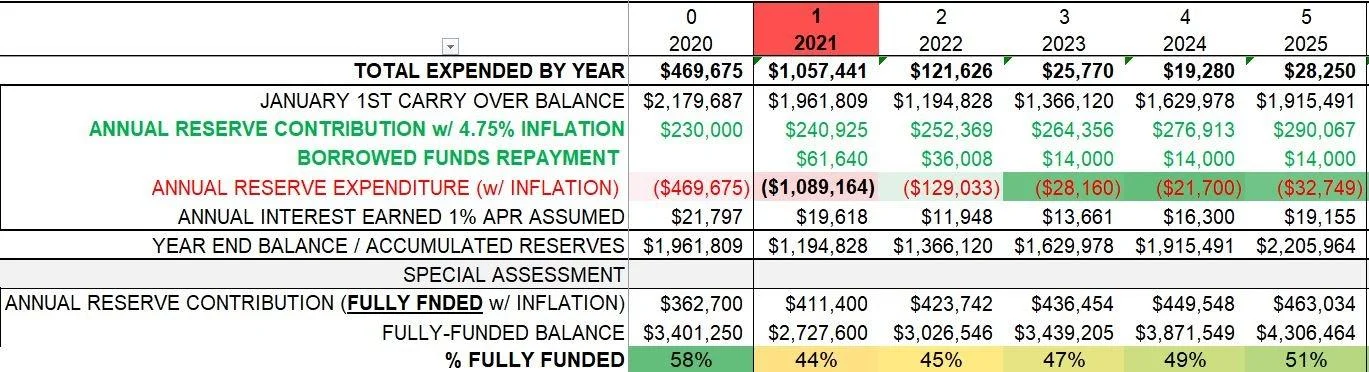
Example Reserve Study Calculator
Articles like this one (written by the banking industry that makes money by holding your funds, paying a paucity of interest and profiting from loans backed by your deposits) suggest that you should “manage” your funds by storing them in “low risk” instruments. This advice directs you to stash your cash in money market funds and certificates of deposit (CDs) that guarantee return of principal, but offer little in terms of yield.
A majority of the advice flooding the internet fails to mention two of the most convenient ways to guarantee return of principal: US Treasuries (Bills, Notes and Bonds) and brokered / institutional CDs. Establishing a brokerage account (options through Charles Schwab, Fidelity, TD Ameritrade or even directly with banks such as Chase, US Bank, Wells Fargo, etc.) opens doors to purchase US Treasuries and brokered CDs.
Brokered CD and US Treasury yields are often substantially more than what you'll earn from CDARs (since rebranded IntraFi Network Deposits) at your local bank. CDARs are "easy" but often return significantly less than other fixed income products that take a little more coordinated effort. A 50bps, 100bps or 200bps nominal yield difference might not seem like much over the course of a few months, but it is significant over time, especially time frames like those of your long-term reserve horizon that stretches over decades.

Fidelity Fixed Income, Bonds & CDs page as of June 8, 2022 – In times of rising federal funds rates, short-term US Treasuries pay a more attractive yield than CDs. In the above example, CDs become more attractive starting at the 3yr duration.
Don't underestimate the impact of an environment with rapidly rising rates driven by substantial action from the US Federal Reserve (i.e. beginning in March 2022). What does that mean for your community? Don't lock yourself into products that will be underwater almost immediately. For example, why would you purchase a one+ year CD or Treasury only to see the one month yield escalate from 1% to what might be 2.5% (driving medium term rates to 4% or more over the next six months)? Your investment product returns should be compared against a strategic investment approach, not simply measured by “something is better than nothing.”
A few things you should know about US Treasuries and brokered CDs:
- As with any financial account, you’ll need to keep your authorized signers up to date. The process might be more arduous than working with your local bank.
- If you do not already have one, you should consider establishing a brokerage account to invest in Treasuries unless your existing banking relationship provides this ability
- US Treasuries generally have a $10MM limit per purchase
- CICs with significant reserves can easily invest in large tranches
- Both FDIC insurance and US government debt securities (Treasuries) are backed by the full faith and credit of the United States of America
- US Treasuries make the $250,000 FDIC insurance limit irrelevant. If the US Government defaults on its debt, gold bullion is likely the only way to guarantee your principal.
- Certain financial institutions allow you to auto-roll your T-Bills just like auto-rolling a CD or IFND
- US Treasury Zero-Coupon Bonds provide a discount to face value at the time of purchase relative to their yield. Their principal value also fluctuates more than other bonds based on FOMC action to adjust overnight interest rates.
- US Treasury I-Bonds adjust their yield semiannually relative to inflation. These bonds pay 9.62% APR between May and October 2022, but there are some hoops:
- A Treasury Direct account; your “Entity Account Manager" MUST:
- be a corporate officer or designated employee and
- be authorized to act alone
- $10,000/yr limit / org for electronic purchases via Treasury Direct
- Must be held a minimum of twelve months
- Redemptions before five years forfeits three months of interest
- A Treasury Direct account; your “Entity Account Manager" MUST:
- Brokered CDs typically pay a higher APY than comparable term CDs from your local or national bank.
- Compare Forbes Advisor and Bankrate with brokered CDs from Fidelity
- Brokered CDs’ principal value can change unless held to maturity
- Time to maturity and interest rates impact the value
- Falling interest rates may allow the sale of a brokered CD for more than its original value
- Rising interest rates may lock in a brokered CD to maturity because disposing of it would result in a loss of principal
- Some states’ ‘Blue Sky’ statutes restrict purchasing brokered CDs from other jurisdictions.
- Time to maturity and interest rates impact the value
- Brokered CDs may include a call option that allows the issuer to redeem them at face value (plus unpaid accrued interest) prior to the stated maturation
When was the last time an investment professional encouraged you to dedicate ALL of your long-term savings in cash and fixed-income securities (money market funds, CDs and US Treasuries) for the next 1, 5, 10, 20, 30 or 40+ years to ensure a well funded retirement?
Investing in a single asset class is a complacent strategy with its own inherent risks. Clinging to low-yielding principal-guaranteed securities and cash is the exact opposite of TINA (There Is No Alternative) that’s dominated the prevailing market philosophy since 2010. Now in 2022, meet PATTY (Pay Attention To The Yield). PATTY means that fixed income is becoming more attractive, but it is never going to be a panacea.
When it comes to stewarding your long-term funds, fixed-income securities are equally “safe” and unequivocally low-yield. Securities that guarantee return of principal are likely to under-perform inflation of any flavor (blended CPI, CPI-U, CPI-W, construction, etc.) over the long-term because they are tied to the federal funds rate. From 1970 until around 2002, the US Federal Reserve’s monetary policy was relatively hawkish resulting in a federal funds rate that often exceeded annual inflation. Especially since the Great Recession from 2007 to 2009, many countries, including the US, have been mired in an extended period of relatively accommodating monetary policy where the funds rate trails inflation.
The following graphs come from the St. Louis Federal Reserve. Select any graph to bring up a larger image. The US Federal Funds Rate is displayed in blue and CPI-U for All Urban Consumers is displayed in brown. View this page to see the numbers side-by-side.
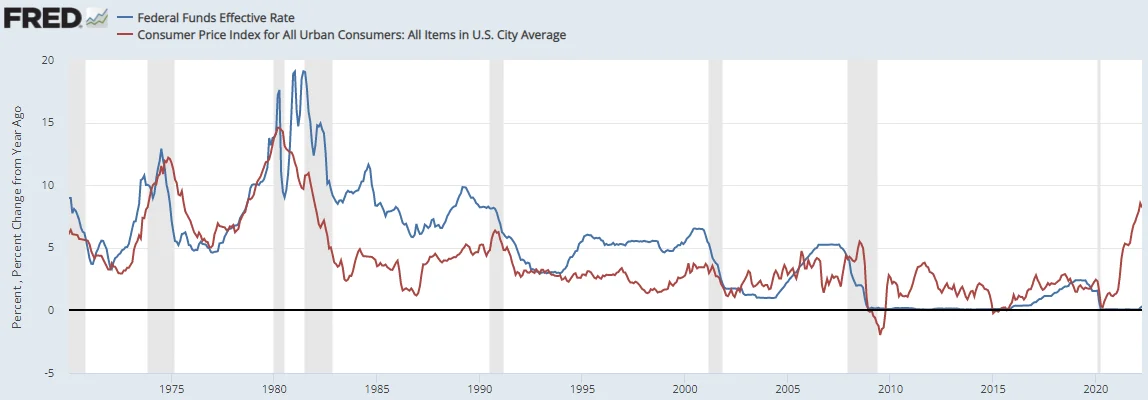
1970 to 2022: Federal Funds Effective Rate + CPI-U (All Urban Consumers)
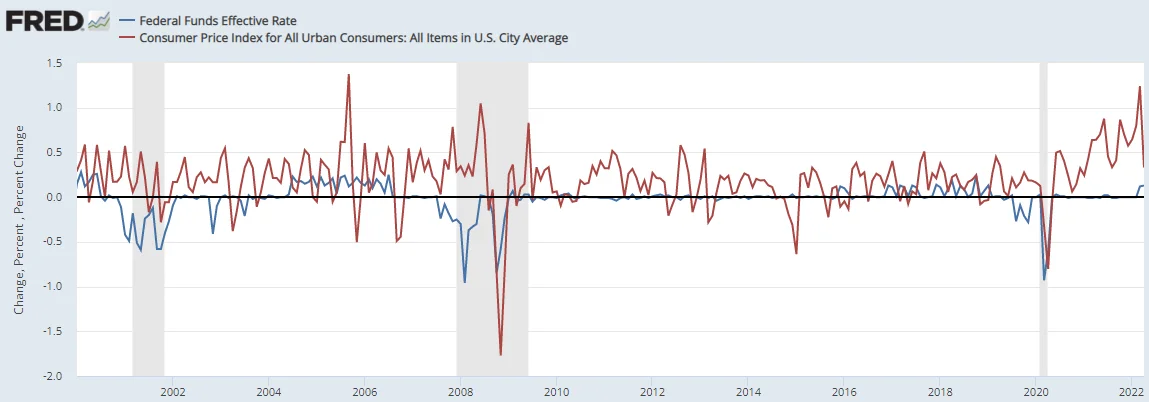
2000 to 2022: Federal Funds Effective Rate + CPI-U (All Urban Consumers)
If the visual immediately above fails to emphasize just how much inflation has increased relative to the federal funds rate, this next graph brings it home:
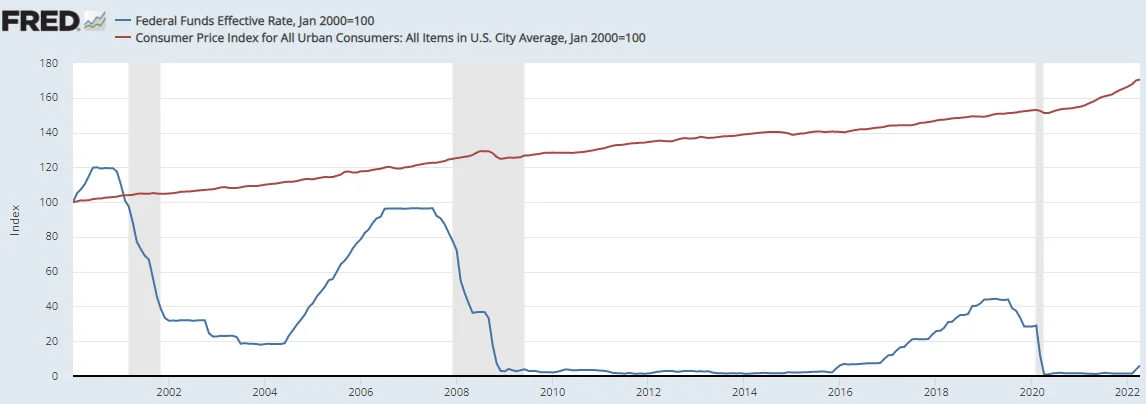
2000 to 2022: Federal Funds Effective Rate + CPI-U (All Urban Consumers)
Indexed to 100 as of January 1, 2001; FFER (Last 5 Years)
Want to consider inflation by itself? Use the BLS CPI Inflation Calculator to see how the value of a dollar has changed over time (based on CPI-U). As of April 2022, $100 stashed in a time capsule from January 2000 and January 2010 has the same buying power as $171.27 (71% decrease) and $133.42 (33% decrease), respectively. Keep in mind that CPI and inflation vary by geography and are measured in separate categories such as consumers, workers and construction. Reserve studies often apply construction inflation to estimate cost increases for most, if not all components (a complacent, yet moderately effective practice).
Has this piqued your interest? Dig deeper and answer four questions:
- How much are your homeowners (members) paying to compensate for reserve investments that perennially underperform inflation?
- Do your state statutes and governing documents restrict the type of investments you can make?
- Is your Board meeting its fiduciary duty or duty of care by failing to look beyond fixed income and/or guaranteed return of principal investments?
- Is your association acting like a prudent investor that has considered all the risks and performed all the appropriate due diligence to make financial decisions that suit time periods from 1 year to 3+ decades?
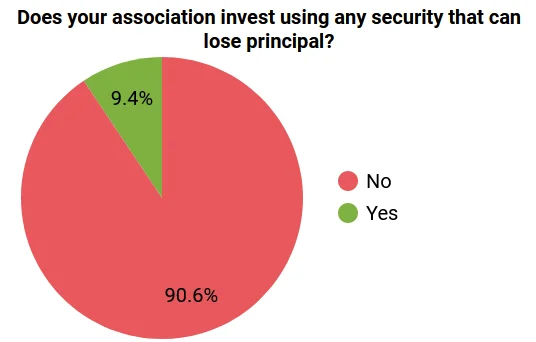
Why don’t more organizations invest their funds to, at minimum, keep up with inflation? One factor is the preponderance of advice suggesting that CICs are either required to avoid and/or “safer” by avoiding any loss of principal. Another is that investment strategies can be complicated. The 2021 Reserve Questionnaire identified only 9.4% of respondents’ CICs have taken the leap to invest in securities where principal is at risk..
Stock market downturns / price declines (which are a natural, healthy expectation) lead many people into confirmation bias and recency bias. It’s easy to grab a specific period of time, show a downtrend and use that in an attempt to justify an argument proving that “investing is risky” or that you will “lose your shirt.” The reality of markets is that they increase in value over time (see below).
Don’t confuse investing with gambling. There is an absolute correlation that major market indices like the Dow Jones, S&P 500 and NASDAQ Composite increase in value over time (despite expected undulations). This correlation is the foundation of “set it and forget it” investing. Market indices statistically outperformed 99% of “managed” funds between 2006 and 2016.
While index funds may seem like an unsophisticated means of investing, they tend to outperform their actively managed counterparts. - Corporate Finance Institute
How do the cumulative returns pictured below compare to the returns your association has earned over the past few years? Easily investable ETF proxies for the indices below are DIA (Dow Jones), QQQ (Nasdaq) and SPY (S&P 500)
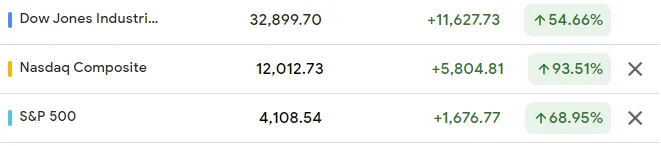
Market Index Chart: June 09, 2017 to June 05, 2022 (5 years)

Market Index Chart: June 15, 2012 to June 05, 2022 (10 years)

Market Index Chart: June 11, 1982 to June 02, 2022 (40 years)
Investing is NEVER one-size-fits-all, but bitcoin, NFTs and stock-picking are no more a solution than depositing 100% of your association funds into fixed-income, principal guaranteed securities that consistently underperform inflation. “Low risk” and “safe” are terms that must be understood in the context of your portfolio objectives. If your accumulated funds are not growing as fast as inflation, your owners’ assessments will inevitably need to increase to account for the difference. There are a nearly infinite number of blended models (90/10, 80/20, 70/30, 60/40, 50/50, etc.) that can help your CIC achieve its objectives.
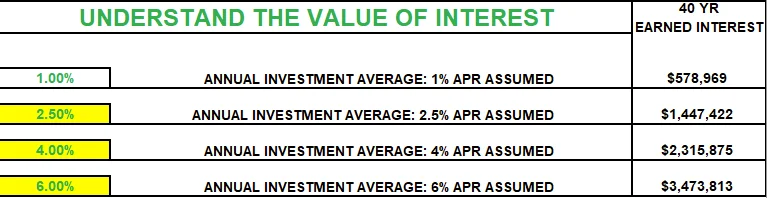
The impact of simple (non-compounded) yield over 40 years. Reserve Study Calculator
CONCLUSION
Don’t allow fear of the unknown to stop your CIC from investing the time and money necessary to create an investment strategy that can stand the test of time. NEXT STEPS to consider:
- Use this free Reserve Study Calculator to estimate your cash flow needs and to better understand how interest compounds over time to supplement your members’ assessments and reserve contributions.
- Understand all restrictions on how your CIC’s funds can be invested
- Some organizations limit themselves to principal-guaranteed securities and others do not.
- Discuss your options with an investment professional
- N.B. Many CICs have dedicated volunteers who are willing and able to create or help create investment policies and strategies. Start with this example Replacement Reserve Funds Management Policy
- Discuss the facts with your members
- Write an investment policy (view example in this Reserve Resource Document)
- Consider updating your declaration / CC&Rs to codify your investment options (which typically requires 67% approval of your members)
- Don’t leave decision-making to the whim of changing Board discretion and lack of continuity over time! Investing – of any kind – requires a plan and steadfast commitment.
- Consider self-managing your investments if they are limited to principal-guaranteed securities
- If your CIC decides to invest in municipal bonds, corporate bonds, equity indices, individual equities or any other securities, you should absolutely:
- have a written investment policy
- hire a professional to manage your funds according to your written policy
- Meet with your investment professional at least annually
- READ: My financial adviser mostly opts for index funds. Is he worth what I pay him?
- “Our psychology tends to sabotage us as investors and it is navigating bear markets where financial advisers really earn their fee, helping us keep calm, avoid bad decisions and stay the course” - Aaron Klein

Don’t Guess. Invest!
Broken Piggy Bank image by markus-s from Pixabay
Money Growth image by nattanan23 from Pixabay
Other images by Google Finance and the Author


